
The Comfort of Stagnation.
Exploitation vs exploration
There is something deeply reassuring about a business plan where the future looks exactly like the past. It’s safe. It’s predictable. It’s also exactly how empires set sails to the museum.
Most organizations build fortresses of efficiency to keep mistakes out. But in doing so, they accidentally lock innovation out, too. If your team isn't allowed to be messy, it may never be brilliant.
Straying from the set path
The most iconic breakthroughs didn't arrive via a boardroom presentation. They were "productive accidents" that someone was smart enough to notice.
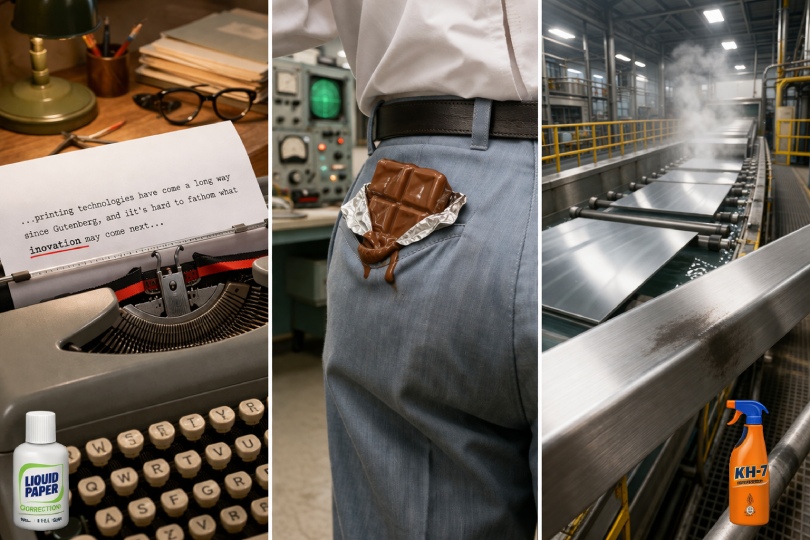
- Let's take for example this frustrated secretary. In the 1950s, Bette Nesmith Graham was tired of retyping pages every time she hit the wrong key. But Bette had a "useless" side-hustle: she was a holiday window painter. She realized that on glass, you just paint over your mistakes. She brought that logic to her garage, bottled some white paint, and created Liquid Paper. A multimillion-dollar empire born from a typo and a hobby.
- Then there’s the physicist who accidentally cooked his lunch. In 1945, Percy Spencer was trying to talk to outer space using magnetron tubes. He failed to reach the aliens, but he did notice the chocolate bar in his pocket had turned into a gooey mess. Instead of cleaning his lab coat and filing a complaint, he leaned into the glitch. He pointed the radiation at corn kernels, and by the end of the year, the Microwave Oven was born.
- Or look at the struggle of a local business owner. Jaume Lloreda had a successful metal coating shop, but he was stuck on a problem with no market solution: industrial grease stains that no product could touch. He didn't have a "Master Plan"; he just had a stubborn stain and a refusal to quit. After 6 failed attempts, the 7th formulation—KH-7 by KH Lloreda didn't just clean his machines; it became Spain’s most famous detergent.
The common thread? They all ignored the "proper" path to play with the problem.
An Innovation Kitchen
I founded FabLab Sant Cugat to be exactly that: an innovation kitchen where we ignored barriers and prioritized the play. I’ve seen this "messy" approach yield world-class results:
- A Startup Kibus Petcare that turned the Nespresso model into a pet food revolution.
- The MBA Students who came and turned "wacky" ideas into viable business ventures.
- The High-schoolers who invented and built hands-free crutches simply because they saw a person walking with crutches helplessly wanting to pick-up is ringing phone.
The French National Lottery had it right in the 90s: "100% of winners have tried their luck."
I can’t give you a recipe for a miracle, but I can help you build the kitchen where miracles happen.
Are you protecting your business from mistakes—or are you accidentally protecting it from the future?